Load, haul & blast Guide
Truck payload: what overloading and underloading cost
Truck payload under Caterpillar's 10/10/20 policy: no more than 10% of loads over 110% of target, none over 120%, mean at or below target, and the costs.
Contents 7 sections
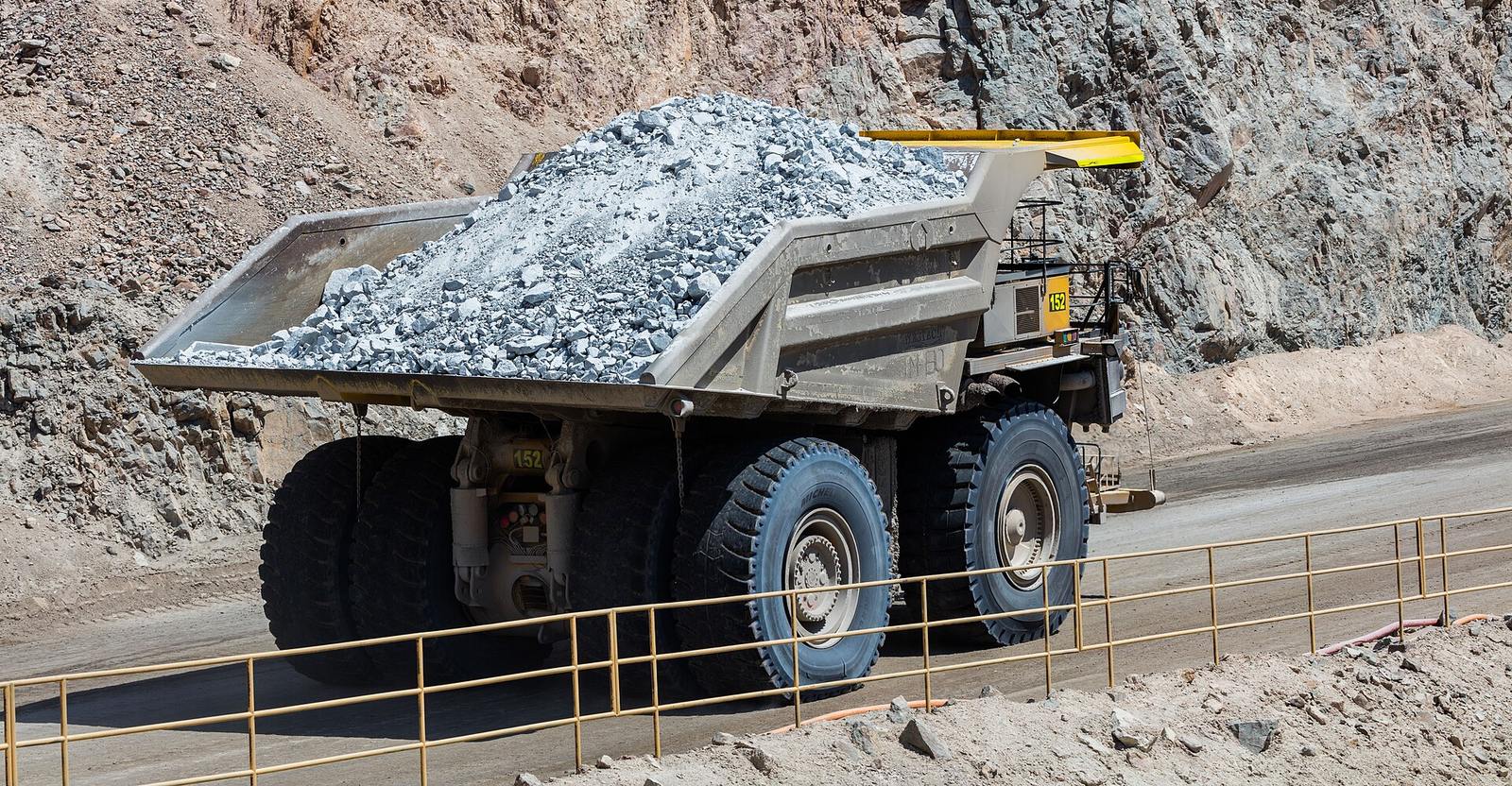
Payload management means loading every haul truck as close to its target payload as possible, with a tight spread either side. Caterpillar’s 10/10/20 policy sets the limits. No more than 10% of loads may be above 110% of target, no load above the maximum allowable payload (typically 120%), and the average at or below target. Overloading shortens tyre and component life and cuts into braking margin; running 10% light needs 11% more loads, and 11% more truck hours, for the same tonnes.
The 10/10/20 policy in Caterpillar’s words
Caterpillar’s loading guidance for its large mining trucks states the policy in two sentences (Caterpillar, 6 loading tips, 2020, read 25 Sep 2026):
“No more than 10% of payloads may exceed 110% of the Field Rated Payload; no single payload shall ever exceed the Maximum Allowable Payload”
“The mean of the payloads shall not exceed the Field Rated Payload, hence no more than 50% of payloads may exceed the Field Rated Payload.”
The flyer gives the Maximum Allowable Payload as “typically 120% of Field Rated Payload”.
Caterpillar’s truck body brochure adds the reason: “Payloads in excess of 120% of nominal exceed the truck’s design parameters. The ideal hauling strategy that maximizes machine and machine component life is to keep the mean of all payloads at or below the machine’s rated target payload” (Cat Truck Bodies, PEDJ0489-01, 2023, read 25 Sep 2026).
The third rule is the easy one to miss. A fleet can keep overloads under 10% and still break the policy if its average sits above target.
| For a truck with a 60-tonne target payload | Limit |
|---|---|
| Average of all loads | 60 tonnes or less |
| Loads above 66 tonnes (110%) | No more than 10% of loads |
| Any single load | Never above 72 tonnes (120%) |
| Loads above 60 tonnes | No more than half |
The policy above is Caterpillar’s. For other makes, take the limits from the truck’s operation and maintenance manual or the dealer, and check the target payload is set for your body, liners and material.
What overloading a haul truck does
Tyres
Caterpillar’s Performance Handbook reproduces a tyre life estimating system from Goodyear, with factors for each operating condition (Caterpillar Performance Handbook 50, p. 22-13, read 25 Sep 2026). For load, the factors are 1.090 at the recommended load, 0.872 at 20% overload and 0.545 at 40% overload. Against the recommended load, that is about 20% less estimated tyre life at a 20% overload and about half the life at a 40% overload. The handbook says the method gives only rough estimates. It also warns that an overload combined with severe maintenance, speed, surface or curve conditions creates “a new and more serious condition”. Heat build-up in tyres under load and speed is covered in TKPH.
Frame, body and running gear
Caterpillar’s loading guidance links loading practice to structural damage: “Extreme drops will cause frame and body damage”, and it warns that loading off centre or on the canopy can cause excessive tyre and suspension wear and balance problems during the haul (Caterpillar, 6 loading tips). A review of payload measurement for haul trucks puts it plainly: “an overloaded truck may cause damage to equipment structural integrity” (Raza 2020, read 25 Sep 2026).
Brakes and steering
The same review warns that an overloaded truck “might exceed the maximum braking and steering limits of truck” (Raza 2020). Retarder and brake charts in the Performance Handbook are read from gross machine weight and effective grade (p. 8-5). If the site’s downhill speed limits were set from those charts at target weight, an overloaded truck is heavier than the limits allow for.
Fuel and carryback
Diesel use rises with payload: “the fuel consumption of the haul trucks also increases with the payload” (Raza 2020). Research by Mining3 and The University of Queensland on a Cat 793D found that “the fuel consumption increases with an increase of the payload variance for all haul road conditions” (International Mining, 7 Dec 2016, read 25 Sep 2026). Material stuck in the body does two kinds of harm. Caterpillar notes that carryback can leave the payload system “recording the carryback on every load”, which inflates production numbers, or ignoring it and “causing the truck to be overloaded”. Any extra weight carried round the circuit costs diesel: on a 793 size machine, Caterpillar puts 2.5 tonnes of extra debris at “approximately 1% additional fuel consumption” (Cat Truck Bodies).
What underloading costs
The operator and the ownership cost of a truck are paid by the hour, whatever is in the body, and the truck hauls its own empty weight both ways on every trip. So the cost of a light load lands on every tonne.
Loads needed = tonnes to move ÷ average payload (tonnes)
Truck hours = loads needed ÷ loads per truck per hour
Haul cost per tonne = truck hours × cost per truck hour (rand) ÷ tonnes moved
Running a fraction x below target raises loads, truck hours and haul cost per tonne by 1 ÷ (1 - x) - 1. At 5% light that is 5.3%; at 10% light, 11.1%; at 15% light, 17.6%.
Light loads often start at the loader. Bucket fill factor falls in poorly blasted rock (see powder factor and fragmentation), so the operator either adds a pass or sends the truck light. Without a payload reading at the face, the loader operator is judging each load by eye. Caterpillar lists the effect of under loading as reducing productivity and increasing “haul cycles, fuel usage, and operating costs” (Performance Handbook 50). The cost of each extra cycle is set out in haul truck cycle time.
How to measure truck payload
| Method | How it works | What to know |
|---|---|---|
| Onboard truck payload system | Pressure sensors in the suspension struts give gross weight; the system subtracts the empty weight | Caterpillar quotes “a payload accuracy of ±5%” for its system (Performance Handbook 50). A Caterpillar patent puts strut-pressure systems at “plus or minus 3-5%” and notes that “strut seal friction and strut rod bending can reduce the accuracy” (US 2004/0104596) |
| Loader or shovel payload system | The loader weighs each bucket and shows a running total | Gives the operator the number before the truck leaves. Easier to keep calibrated, since “there are always fewer shovels as compared with the number of trucks” (Raza 2020) |
| Weighbridge or portable wheel scales | The truck is weighed full and empty | The reference for calibrating onboard systems. Fixed scales add distance and time to the haul, so they are kept for periodic checks (Raza 2020) |
Strut-pressure systems settle their reading after the truck moves off: “the modern on-board payload measurement systems for trucks only measure accurately when they haul starts” (Raza 2020). That is too late to fix the load at the face, which is why a loader-side reading matters.
Calibration drifts. A payload calibration study at a large surface mine checked 31 haul trucks against ground scales. Of those, 17 trucks (54%) had no issues and 4 (13%) were questionable. The other 10 (32%) were confirmed as faulty, with an error “consistently more than the desired tolerance limit of 5%” (Raza 2020). The paper’s conclusion is that onboard systems “must be calibrated regularly using external scales”. A payload figure is only as good as its last calibration, so record the calibration date next to the monthly payload report.
Checking a shift against 10/10/20
As an illustrative example, take 20 loads from one shift on 60-tonne trucks: 58, 61, 63, 57, 60, 66, 59, 62, 55, 64, 60, 67, 58, 61, 56, 63, 59, 62, 60 and 57 tonnes. One load (67 t) is above 66 tonnes, so 5% of loads exceed 110%. None is above 72 tonnes. The average is 60.4 tonnes, or 100.7% of target. The shift passes the first two tests and fails the third, because its average is above target.
Payload is one input to the site’s cost per tonne. A tight spread around target keeps both the maintenance bill and the haul cost per tonne down.
Common questions
What does 10/10/20 mean for a 60-tonne truck?
No more than 10% of loads above 66 tonnes, no load ever above 72 tonnes, and the average of all loads at or below 60 tonnes. The average rule means no more than half the loads may be above 60 tonnes.
Is it cheaper to overload a little than to run light?
Not over the life of the truck. Each tonne above target is carried at the cost of tyre life, frame and component life and braking margin, and the OEM treats loads above 120% of target as outside the truck’s design. Aim for an average at target with a tight spread.
How accurate is an onboard payload system?
Caterpillar quotes ±5% for its truck production management system, and a Caterpillar patent puts strut-pressure systems at 3% to 5%. Calibrate against a weighbridge or portable scales: a 31-truck study found 10 trucks consistently outside a 5% tolerance.
Sources
- Caterpillar, Cat Large Mining Trucks: 6 loading tips to help improve truck reliability, 2020. Read 25 Sep 2026.
- Caterpillar, Cat Truck Bodies, PEDJ0489-01, 2023. Read 25 Sep 2026.
- Caterpillar, Caterpillar Performance Handbook, Edition 50 (SEBD0351-50), June 2022, pp. 8-5 and 22-13 and the technology section. Read 25 Sep 2026.
- Raza, M., Calibration of Payload Measurement System for Mining Haul Trucks, International Journal of Mining Science 6(2), 2020, pp. 34-40. Read 25 Sep 2026.
- Bender, J. (Caterpillar Inc.), US 2004/0104596 A1, Dump truck with payload weight measuring system and method of using same, published 3 Jun 2004. Read 25 Sep 2026.
- International Mining, Mining3 project looks at effect of payload variance on haul truck fuel consumption, 7 Dec 2016. Read 25 Sep 2026.