Load, haul & blast Glossary Global
Spacing in blasting: the distance between holes in a row
Spacing is the distance between neighbouring blastholes in a row. It is usually 1 to 2 times the burden. How to set it and what it does to drilling.
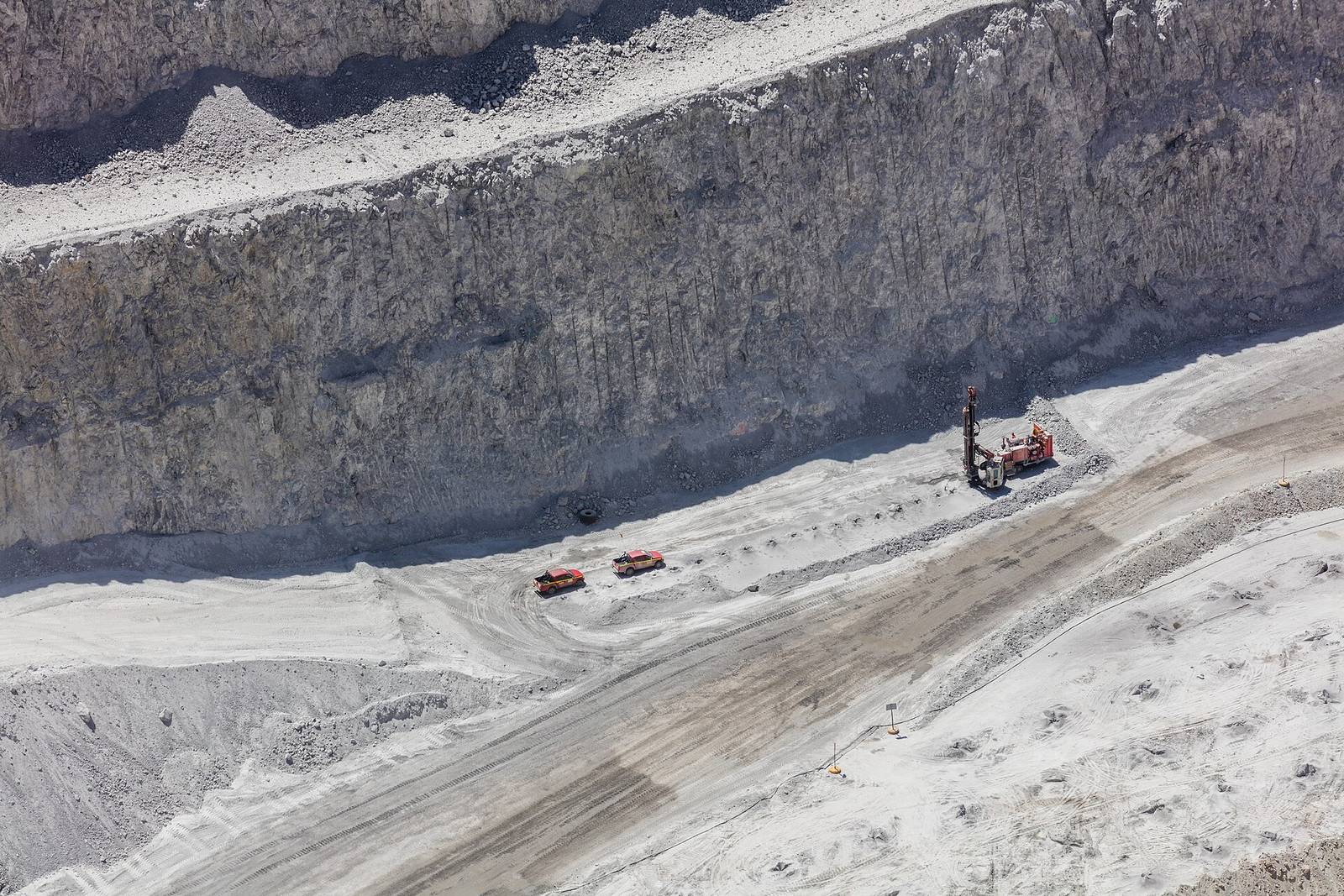
Definition
Spacing (blasting)
In blasting, spacing is the distance between adjacent blastholes in the same row, measured along the row at right angles to the burden.
Contents 5 sections
Most blast designs put neighbouring holes in a row between one and two burdens apart, and that distance governs how their charges work together. Because the drill has to put down one hole for every burden × spacing of ground, it also sets how many holes and drill metres each shot costs.
Why neighbouring holes matter
Agyei and Owusu-Tweneboah, writing in the Ghana Mining Journal in 2019, describe spacing as the dimension that “controls the mutual effect between holes”. It depends on the burden, the hole depth, where the primers sit in adjacent holes and the initiation interval between them (Agyei and Owusu-Tweneboah 2019, read 25 Sep 2026).
The paper describes both sides of the target:
- Too close. Radial cracks from neighbouring holes link too early and form a fracture plane between them. Gas escapes along it, causing airblast, flying rock and toes. Close spacing also causes crushing and cratering between holes and leaves large blocks in the burden.
- Too wide. Adjacent charges lose their interaction. Fragmentation is coarse and the blast leaves toes and rough, uneven walls.
OSMRE, the US surface mining regulator, ties spacing to the firing sequence in its blaster training: one of its listed causes of excessive airblast is “delay sequencing across the front face relative to hole spacing”. Its list of flyrock causes includes spacing and burden that exceed the depth of the hole (OSMRE Module 8, read 25 Sep 2026).
Setting spacing from the burden
Spacing S (m) = 1 to 2 × burden B (m), typically 1.5 × B (OSMRE)
Konya and Walter: S (m) = (bench height H (m) + 7 × B (m)) ÷ 8
Spacing to burden ratio = S ÷ B
Area per hole (m²) = B × S
For surface coal, the US Office of Surface Mining supplies the 1 to 2 band and the typical 1.5 (OSMRE, Blast Design Rules of Thumb, read 25 Sep 2026). The Konya and Walter expression is the one tabulated in the Tarkwa paper, which also puts the ratio at 1 to 2 “for most situations”. Both expressions start from the burden, so spacing is always the second figure chosen.
Spacing in fragmentation models
A study of the Aitik mine published by the SAIMM discusses a crusher energy model whose feed fragmentation comes from the Kuz-Ram model and is treated as “a function of burden and spacing”. The authors point out that lithology, structural geology, explosive performance and drilling precision make run-of-mine fragmentation vary anyway (Beyglou, Johansson and Schunnesson 2017, read 25 Sep 2026). The drill pattern sets up the blast, and the rock in that bench still decides how it breaks. For what that means at the loader and crusher, see powder factor and fragmentation.
Common questions
What is a normal spacing to burden ratio?
Between 1 and 2 for most situations. OSMRE’s coal rules of thumb use 1.5 as the typical figure. The Fobinso pit design in the Ghana Mining Journal used 3.5 m spacing on a 3.1 m burden, a ratio of about 1.1.
What happens if blastholes are too close together?
Cracks from neighbouring holes join early and open a path for the gases to escape, which causes airblast, flyrock and toes. The Tarkwa paper also lists crushing and cratering between holes and large blocks left in the burden.
What happens if the spacing is too wide?
The charges stop helping each other break the rock between them. Fragmentation turns coarse and the paper reports toes and rough, uneven walls.
Sources
- Agyei, G. and Owusu-Tweneboah, M., A Comparative Analysis of Rock Fragmentation using Blast Prediction Results, Ghana Mining Journal 19(1), 2019, pp. 49-58. Read 25 Sep 2026.
- US Office of Surface Mining Reclamation and Enforcement, Blast Design Rules of Thumb - Coal. Read 25 Sep 2026.
- US Office of Surface Mining Reclamation and Enforcement, Blaster training Module 8: Controlling the Adverse Effects of Blasting. Read 25 Sep 2026.
- Beyglou, A., Johansson, D. and Schunnesson, H., Target fragmentation for efficient loading and crushing: the Aitik case, Journal of the Southern African Institute of Mining and Metallurgy 117(11), 2017. Read 25 Sep 2026.