Maintenance Glossary Global
MTBF for mining equipment, with a worked example
MTBF is total operating hours divided by the number of failures. How to count both on a mining fleet, with a worked haul truck example.
Definition
MTBF
MTBF (mean time between failures) is the average operating time a repairable machine runs between one failure and the next, calculated as total operating hours in a period divided by the number of failures in that period.
Contents 9 sections
On a mining fleet the figure only means something once the site has written down what counts as a failure and which hours count as operating time. The same eight trucks can report an MTBF anywhere from 133 to 331 hours depending on those two choices.
MTBF formula
MTBF (hours) = total operating hours in the period ÷ number of failures in the period
This is the estimate the NIST engineering statistics handbook gives for a repairable system: total operating time divided by total failures (NIST e-Handbook 8.4.5.1, read 25 Sep 2026).
Two terms need a written definition before anyone divides:
- Operating hours. The Global Mining Guidelines Group (GMG) defines Operating Time as time when “the equipment is available and under the control of a human or system”, and notes that the meaning of “operating hour” varies throughout the mining community (GMG time classification framework, 2020). Downtime, standby and unscheduled time are left out.
- Failure. ISO 14224 defines a failure as the “loss of ability to perform as required” (ISO 14224:2016, 3.23).
What counts as a failure
A breakdown that stops the machine is a failure. A planned service is downtime, and it is not a failure. ISO 14224 treats a machine as down during a fault or preventive maintenance, and says down time “can be either planned or unplanned”. Only the unplanned stops belong in the MTBF count.
ISO 14224 also separates a critical failure, which stops the function and “results in an unscheduled repair”, from a degraded failure, which compromises a function without stopping it. Decide whether degraded failures count toward MTBF, write the rule down and apply it to every machine.
Worked example: eight haul trucks in one month
The same fleet, calculated five ways
The same illustrative trucks, with the rules changed:
| Method | Calculation | MTBF (hours) |
|---|---|---|
| Operating hours, breakdowns only | 3,460 ÷ 18 | 192 |
| Planned services also counted (one per truck) | 3,460 ÷ 26 | 133 |
| Engine hours, which ran during standby and warm-up (illustrative 3,780) | 3,780 ÷ 18 | 210 |
| Calendar hours (8 trucks × 744) | 5,952 ÷ 18 | 331 |
| Average of the seven per-truck MTBFs | 1,660 ÷ 7 | 237 |
The first line is the fleet MTBF. The last line is a spreadsheet error: averaging per-truck figures gives a truck with one failure the same weight as a truck with five. Pool the hours and the failures, then divide.
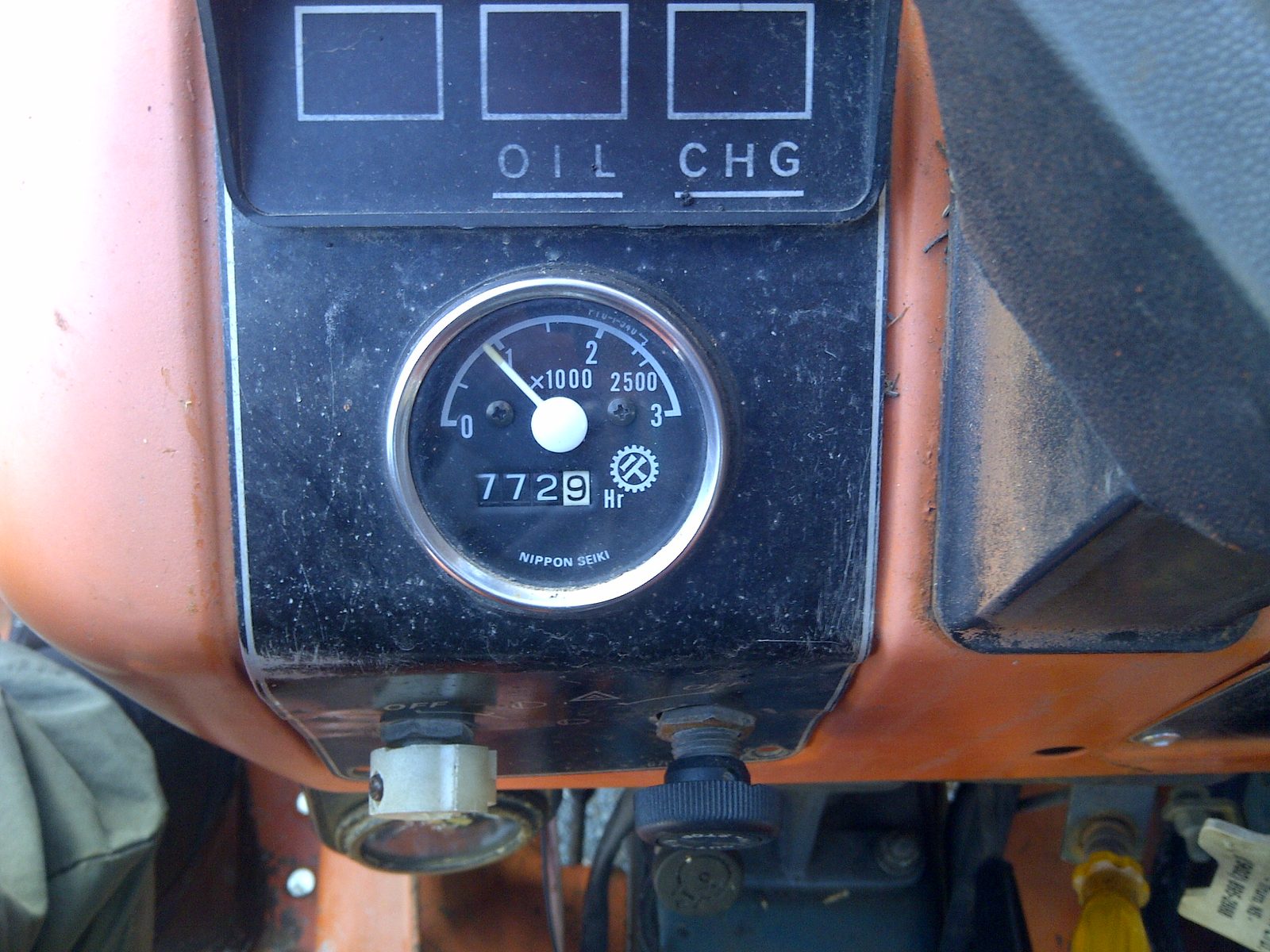
Engine hours are a different measure. GMG describes meter hours as “the time the unit is running”, so they include an engine idling through a shift change. Keep engine hours for services and operating hours for MTBF, and say which one a report uses.
MTBF from small samples
One truck’s month is a small sample. NIST gives confidence factors for an MTBF estimated from a few failures: at 90% confidence and five failures, the true MTBF lies between 0.4756 and 2.5379 times the estimate. For RDT04, that turns 78 hours into a range of about 37 to 198 hours. With one failure the range runs from 0.21 to 19.5 times the estimate (NIST e-Handbook 8.4.5.1).
Those factors assume a constant failure rate. A worn machine near a rebuild breaks that assumption. For decisions about a single machine, use several months of data or the class figure.
The difference between MTBF and MTTF
MTBF applies to machines that are repaired and go back to work. MTTF (mean time to failure) is the mean life of items that are replaced rather than repaired. NIST lists it under lifetime models for non-repairable populations, where for a constant failure rate MTTF = 1/λ (NIST e-Handbook 8.1.6.1). A haul truck has an MTBF. Many of the components swapped out of it have an MTTF.
How MTBF links to availability
MTBF sets how often a machine goes down. MTTR sets how long each stop lasts. Together they give inherent availability (US DoD RAM guide, 2005, Table 3-4):
A = MTBF ÷ (MTBF + MTTR)
With the fleet’s 192 hours and an illustrative MTTR of 6 hours, A = 192 ÷ 198 = 97.0%. That figure ignores planned services and waiting for parts, so it usually sits above the mechanical availability a site reports (see availability and utilisation).
Both numbers are only as good as the breakdown record: each failure needs a job card with the machine, the time it stopped and the time it went back to work.
Common questions
Is a planned service a failure for MTBF?
No. A failure is a loss of the ability to perform as required. A planned service takes the machine down but is not a failure, so it goes into downtime and availability, and stays out of the MTBF failure count.
Should MTBF use engine hours or operating hours?
Use one basis and state it. Engine hours record when the engine ran, including standby and warm-up, so they give a higher MTBF than operating hours from the time model. Never mix the two in one fleet figure.
What is the difference between MTBF and MTTF?
MTBF is for repairable machines that go back to work after a repair. MTTF is the mean life of items that are replaced rather than repaired, such as many components.
Sources
- NIST/SEMATECH e-Handbook of Statistical Methods, 8.4.5.1 Constant repair rate (HPP/exponential) model, NIST, read 25 Sep 2026.
- NIST/SEMATECH e-Handbook of Statistical Methods, 8.1.6.1 Exponential, NIST, read 25 Sep 2026.
- ISO 14224:2016, clause 3 terms and definitions (preview), ISO, read 25 Sep 2026.
- A Standardized Time Classification Framework for Mobile Equipment in Surface Mining (2020), Global Mining Guidelines Group, read 25 Sep 2026.
- DoD Guide for Achieving Reliability, Availability, and Maintainability (2005), Table 3-4, US Department of Defense, read 25 Sep 2026.