Load, haul & blast Glossary Global
Match factor: sizing trucks to loaders
Match factor = trucks × loading time per truck ÷ (loaders × truck cycle time). Below 1 the loader waits; above 1 trucks queue. Worked excavator example.
Definition
Match factor
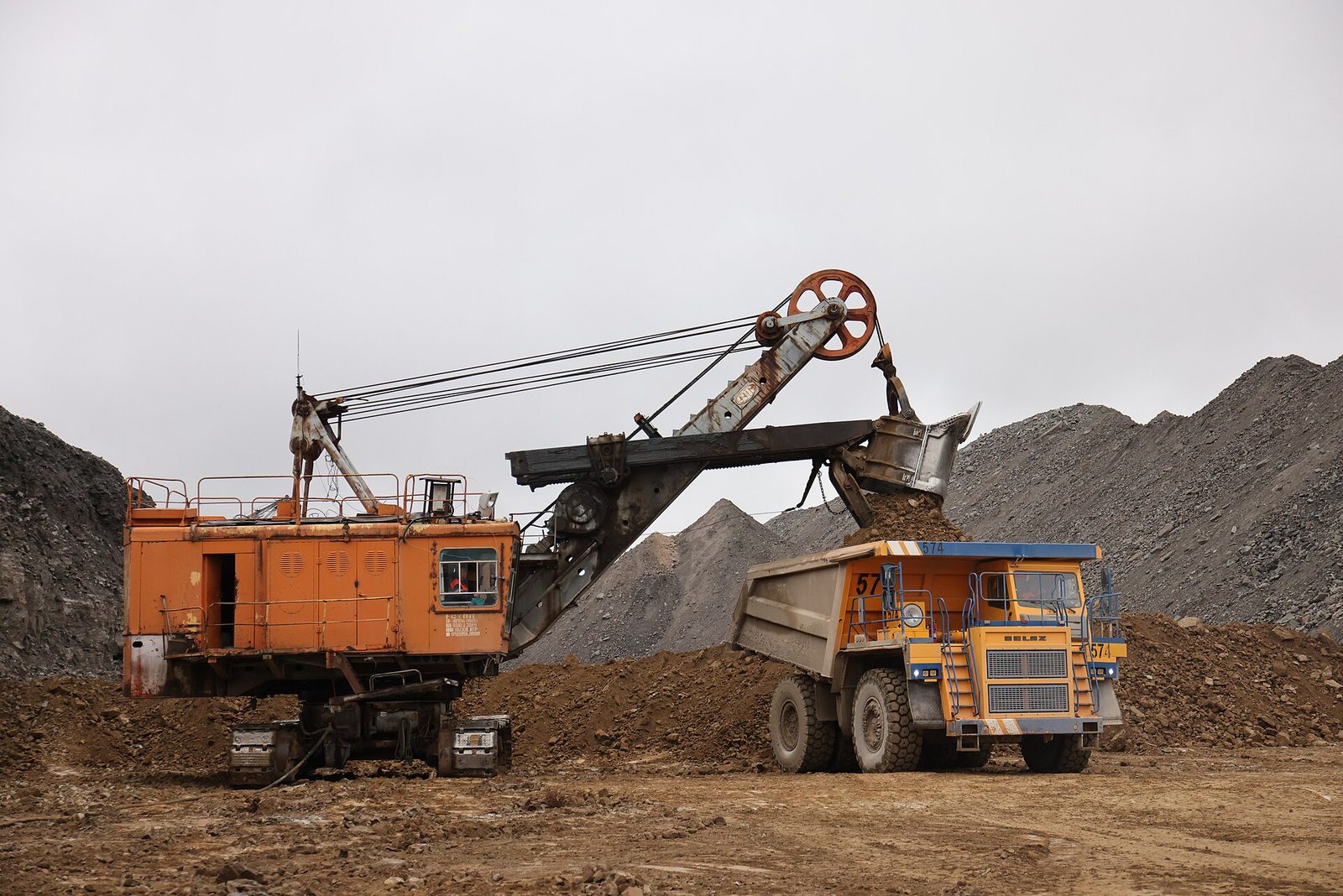
Match factor is the ratio of the rate at which trucks arrive at a loader to the rate at which the loader can fill them, calculated as the number of trucks times the time to load one truck, divided by the number of loaders times the truck cycle time.
Contents 6 sections
Below a match factor of 1 the loader stands waiting for trucks; above 1 the trucks queue at the loader. The ratio is used to size a truck fleet once the loader and truck type have been chosen. Burt and Caccetta call it “an important productivity index in the mining industry” and note that a 2000 study found the earthmoving industry still used it that way (Burt and Caccetta, review draft, 2013).
Match factor formula
MF = (number of trucks × loader cycle time per truck) ÷ (number of loaders × truck cycle time)
Loader cycle time per truck = the time the loader takes to load one truck (minutes)
Truck cycle time = the average truck cycle excluding waiting time (minutes)
This is the form given in the Journal of the Southern African Institute of Mining and Metallurgy by Dey, Mandal and Bhar, citing Hanby (1991) and Kesimal (1998). Their equation writes it as “No. of truck × shovel cycle time” over “No. of shovel × truck cycle time”, and defines the shovel term as the time taken to load a truck (Dey et al., J SAIMM 122(10), 2022, read 25 Sep 2026).
Two details decide whether the number means anything:
- Loader time is per truck. It is the bucket cycle times the number of passes, plus any time the loader stands while trucks exchange under it. Five 0.48 minute passes with a 0.7 minute exchange is 3.1 minutes per truck.
- Truck cycle time leaves out waiting. Dey et al. define it as the average cycle “excluding waiting times”. If queue time is left in, the ratio comes out lower and hides the queue it should be showing.
What a match factor above or below 1 means
| Match factor | At the loader | What it tells you |
|---|---|---|
| Below 1 | Loader waits for trucks | Under-trucked. Production is set by the trucks. |
| 1 | No queue, no loader waiting | Balanced on paper. Not reached in practice. |
| Above 1 | Trucks queue | Over-trucked. The loader runs flat out; trucks stand. |
The University of Alberta’s mining optimisation group sums up Burt and Caccetta: at MF above 1 “the loader is 100% efficient, and trucks are queued”, and MF of 1 is the optimal situation “but not achievable realistically due to bunching and maintenance” (Al-Masri et al., MOL Report Ten, 2022). The same paper simulates a loader breakdown: trucks from the stopped shovel move to the working one, and that shovel’s match factor rises to 1.5.
Worked example: one excavator, how many trucks?
The choice between 7 and 8 trucks is a cost question: an idle excavator against a truck standing in the queue. Price both per hour on your own rates before picking the side of 1 you want to sit on.
Match factor with mixed fleets
The simple formula assumes one truck type and one loader type. Put a 40 tonne truck and a 60 tonne truck under the same excavator and they take different numbers of passes, so there is no single loader time per truck. Burt and Caccetta extended the formula in 2007 to cover mixed truck and loader fleets and different truck cycle times (Burt and Caccetta 2007); Dey et al. reproduce the heterogeneous form from Burt’s 2008 thesis. If your fleet is mixed, calculate a match factor per loader using that form, or keep truck classes on separate loaders.
Common questions
What is a good match factor?
A match factor of 1 means no queue and no loader waiting, but researchers note it is not achievable in practice because trucks bunch and machines break down. Sites choose a target either side of 1 depending on whether idle loader time or idle truck time costs them more.
Does truck cycle time include queuing?
No. In the formula as the SAIMM journal states it, truck cycle time is the average cycle excluding waiting time. Including queue time inflates the cycle and makes the match factor look lower than it is.
Can I use match factor with mixed truck sizes?
Only with care. The simple formula assumes one truck type and one loader type. Burt and Caccetta published an extension for mixed fleets in 2007, because different trucks take different times to load.
Sources
- Dey, S., Mandal, S.K. and Bhar, C. (2022). Application of MR and ANN in the prediction of the shovel cycle time. Journal of the Southern African Institute of Mining and Metallurgy, 122(10). Read 25 Sep 2026.
- Al-Masri, M. et al. (2022). Loading in trucks and shovels under uncertainties. MOL Report Ten, University of Alberta. Read 25 Sep 2026.
- Burt, C. and Caccetta, L. Equipment Selection for Surface Mining: A Review (draft, 2013). Read 25 Sep 2026.
- Burt, C.N. and Caccetta, L. (2007). Match factor for heterogeneous truck and loader fleets. International Journal of Mining, Reclamation and Environment, 21(4), 262-270. Bibliographic record read 25 Sep 2026.
- Caterpillar Performance Handbook, Edition 50 (SEBD0351-50, June 2022). Caterpillar. Read 25 Sep 2026.