Load, haul & blast Glossary Global
Rolling resistance on haul roads, with a worked example
Rolling resistance is the force a haul truck overcomes to roll, as a % of gross weight: 1% is 10 kg per tonne. Formulas, typical values, a ramp example.
Definition
Rolling resistance
Rolling resistance is the force a haul truck must overcome to roll over the road surface, expressed as a percentage of gross machine weight, where each 1% equals 10 kg of resistance for every tonne the truck weighs.
Contents 7 sections
Add rolling resistance to the road grade and you get total resistance, or effective grade. That number sets how much rimpull and power a loaded truck needs to climb a ramp, and so how fast it climbs.
Roger Thompson attributes rolling resistance mostly to road deformation under the tyre, tyre penetration into the road and the tyre deforming the road surface (Thompson 2011). Caterpillar adds that the tyre’s own losses come mainly from heat generated as the rubber flexes, and depend on inflation pressure, temperature, tread, load and speed (Caterpillar Performance Handbook 50, p. 25-6, read 25 Sep 2026).
How rolling resistance is calculated
Rolling resistance (%) = 2% + 0.6% per cm of tyre penetration
Rolling resistance (kg) = rolling resistance factor (kg per tonne) × gross machine weight (tonnes), where the factor = 20 kg per tonne + 6 kg per tonne per cm of penetration
Grade resistance (kg) = 10 kg per tonne × % grade × gross machine weight (tonnes)
Total resistance = rolling resistance + grade resistance
Effective grade (%) = rolling resistance (%) + grade (%)
The 2% base is Caterpillar’s conservative starting point. Its handbook puts the minimum at 1% to 1.5% of gross machine weight on tyres, and says the road does not need to rut for resistance to rise: a surface that flexes under load has “nearly the same” effect (Caterpillar, p. 25-7). A road where tyres sink 2 cm therefore works out at 2% + 1.2% = 3.2%.
Because 1% of grade and 1% of rolling resistance both cost 10 kg per tonne, they add directly: a truck on a 6% ramp with 3% rolling resistance climbs a 9% effective grade.
Typical values by road condition
Thompson’s course notes rate a strong, hard, compacted and maintained haul road with no discernible tyre penetration at 2%, and an intermediate-strength, frequently maintained road with minimal penetration at 2% to 3%. His table then climbs in steps as the road materials weaken and tyres sink deeper (Thompson, haul road design notes, 2015).
Caterpillar’s handbook table is headed “For Earthmoving and NON-Mining/Quarry Applications”. Values for radial tyres:
| Underfooting | Radial tyres |
|---|---|
| Very hard, smooth roadway, no penetration or flexing | 1.2% |
| Hard, smooth, stabilised road, watered and maintained | 1.7% |
| Firm, smooth road flexing slightly, maintained fairly regularly, watered | 2.5% |
| Dirt road, rutted or flexing, little maintenance, no water, 25 mm penetration | 4.0% |
| Same, 50 mm penetration | 5.0% |
| Rutted dirt road, soft, no maintenance, 100 mm penetration | 8.0% |
| Loose sand or gravel | 10.0% |
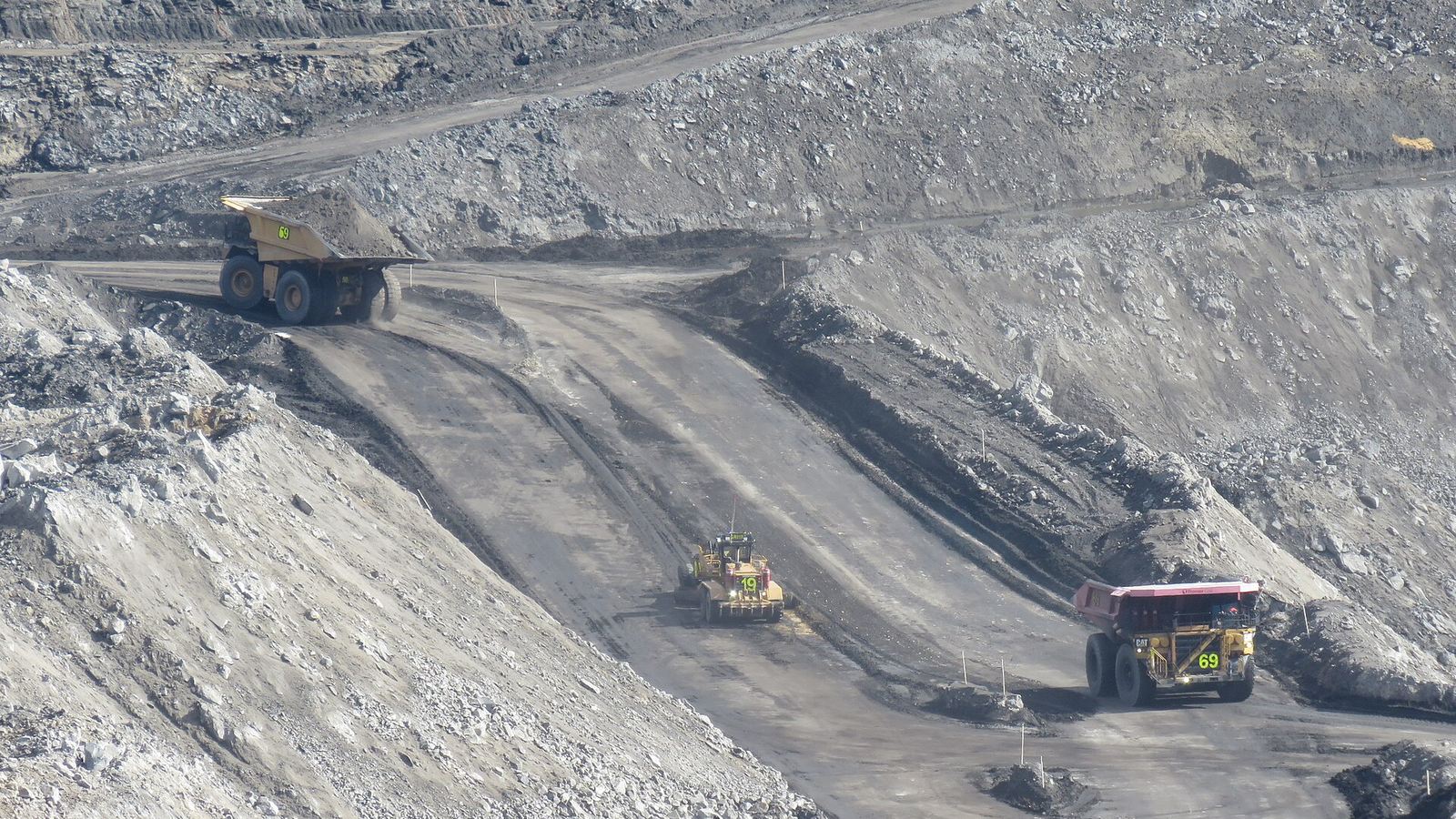
For mining, Caterpillar no longer prints a table. Its handbook reports performance studies with speed traps that put mining truck haul ramps at 1.25% to 1.5% effective grade of resistance, and says the old tables “changed little in 50 years” despite bigger trucks and better tyres (Caterpillar, p. 25-6). It places rough ground mainly in load and dump areas and short seasonal spells.
Rolling resistance going downhill
Downhill, rolling resistance works for the truck. Effective grade is the grade minus rolling resistance (Thompson 2011). Caterpillar’s example: a 20% favourable grade with 5% rolling resistance gives a 15% total effective grade for the retarder chart (p. 8-5).
So the safe assumption flips: a higher rolling resistance is conservative for uphill propulsion, a lower one for downhill retarding and braking (Caterpillar, p. 25-6).
Worked example: a loaded truck on a ramp
What changes when rolling resistance rises
Thompson’s rule of thumb, from a 2% base: each extra 1% of rolling resistance costs about 10% of truck speed on a ramp and 26% on a flat road (Thompson 2011, from a performance chart for an ultra-class truck of about 4.3 kW net per tonne GVM). Flat hauls suffer more because rolling resistance is most of the resistance there.
Drive type matters. Caterpillar says an electric drive truck’s speed changes in step with resistance, while a mechanical drive truck may show no change or lose a whole gear, depending on whether it was near a shift point (p. 25-6). On Thompson’s figures, a soft patch on a long flat haul costs more speed per percentage point than the same patch on a ramp, so flat sections deserve the same grader time.
Common questions
What is a normal rolling resistance for a mine haul road?
About 2% on a hard, compacted, well-maintained road with no tyre penetration (Thompson). Caterpillar adds 0.6% for each centimetre the tyres sink, so 2 cm of penetration gives about 3.2%. Its speed-trap studies put mining truck haul ramps at 1.25% to 1.5%.
Is rolling resistance the same as grade?
No. Grade is the slope of the road. Rolling resistance comes from tyre flexing and the road giving way under the tyre. Both are expressed in percent and add together as total resistance, also called effective grade.
Does rolling resistance help a loaded truck going downhill?
Yes. Downhill, effective grade is the grade minus rolling resistance. For retarding and braking estimates, Caterpillar advises a lower rolling resistance value, because that gives the more conservative result.
Sources
- Caterpillar Performance Handbook, Edition 50 (SEBD0351-50, June 2022), sections 8, 25 and 27. Caterpillar. Read 25 Sep 2026.
- Principles of Mine Haul Road Design and Construction, v5, September 2015. R.J. Thompson. Read 25 Sep 2026.
- GSFM: An Integrated Approach to Mine Haul Road Design (2011). R.J. Thompson, Western Australian School of Mines, Curtin University. Read 25 Sep 2026.