Markets Briefing Africa
Mining in Namibia: a briefing for South African contractors
Namibia mining: uranium output rose 20.8% in 2025 as diamonds fell. Where contractors work, ownership policy, permits, tax and border posts for SA firms.
Contents 10 sections
Namibia’s uranium output rose 20.8% in 2025, by the Chamber of Mines’ count, while diamond production fell 5.6% and mining’s real value added contracted 9.4%. Uranium from the Erongo Region and gold are carrying the industry, and new uranium and gold mines are under construction. A South African contractor can work there. No law read for this briefing reserves mining contracts for Namibian firms. Even so, mines spent 65% of their procurement locally in 2025, and local ownership policy is still being settled.
Figures and rules checked 25 Sep 2026.
Mining in Namibia: key figures
| Measure | Figure | Year | Source |
|---|---|---|---|
| Mineral sales | N$64.18 billion, up 25% | 2025 | Chamber of Mines Annual Review 2025 |
| Mining share of GDP | 14% | 2025 | Chamber of Mines Annual Review 2025 |
| Mining real value added | down 9.4% | 2025 | Namibia Statistics Agency, in Chamber review |
| Uranium production | up 20.8% | 2025 | Chamber of Mines Annual Review 2025 |
| Husab uranium oxide output | 5,428 tonnes | 2025 | Chamber of Mines Annual Review 2025 |
| Rössing uranium oxide output | 3,185 tonnes | 2025 | Chamber of Mines Annual Review 2025 |
| Langer Heinrich uranium oxide output | 1,832 tonnes | year to 30 June 2025 | Chamber of Mines Annual Review 2025 |
| Diamond production (Chamber members) | down 5.6% | 2025 | Chamber of Mines Annual Review 2025 |
| Gem-quality diamond production (estimate) | 2.3 million carats | 2025 | USGS MCS 2026, Gemstones |
| Direct mining employment | 20,798 | 2025 | Chamber of Mines Annual Review 2025 |
| Local procurement | N$23.97 billion, 65% of procurement | 2025 | Chamber of Mines Annual Review 2025 |
| Royalties paid | N$2.458 billion | 2025 | Chamber of Mines Annual Review 2025 |
| Exploration spending | N$1.496 billion, up 22% | 2025 | Chamber of Mines Annual Review 2025 |
Sources: Chamber of Mines of Namibia, Annual Review 2025, USGS MCS 2026 Gemstones, both read 25 Sep 2026. The Chamber’s figures cover its members; employment and exploration totals include exploration companies.
Where mining happens in Namibia
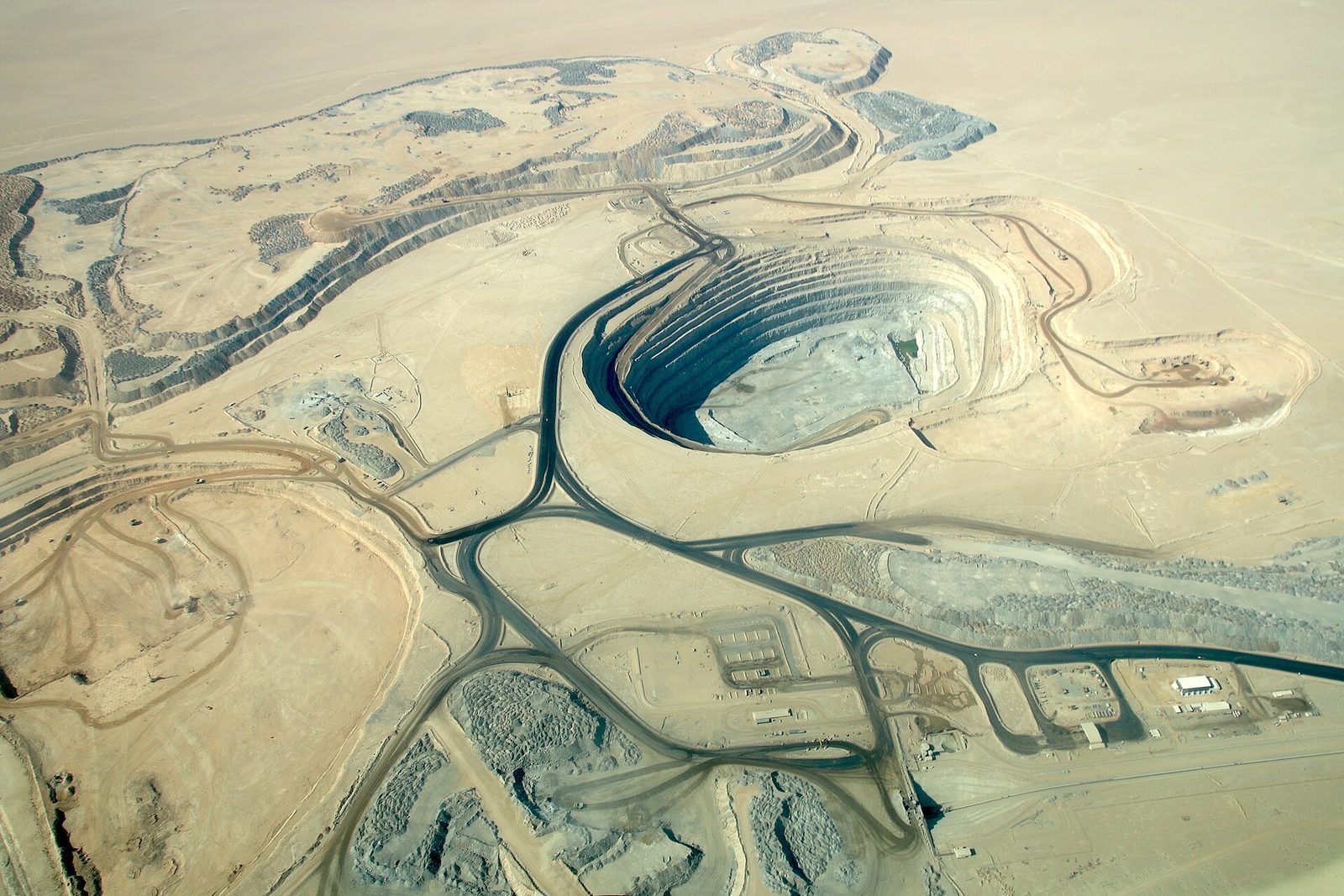
Uranium comes from three mines in the Erongo Region: Husab near Swakopmund, Rössing and Langer Heinrich. USGS ranked Namibia the third-largest uranium producer in 2020, citing the World Nuclear Association (USGS 2020-21 Minerals Yearbook, Namibia). The Chamber’s company pages show how much of the work is done by contractors.
| Mine | Uranium oxide, 2025 | Permanent employees | Contractors employed | Note |
|---|---|---|---|---|
| Husab (Swakop Uranium) | 5,428 tonnes | 1,596 | 2,050 | Moved 114 million tonnes of ex-pit material in 2025 |
| Rössing | 3,185 tonnes | 740 | 1,783 | Open pit in operation for over 49 years |
| Langer Heinrich | 1,832 tonnes (year to 30 June) | 408 | more than 1,100 | Mining resumed in 2025; 84% of procurement spent locally |
Source: company pages in the Chamber of Mines Annual Review 2025, read 25 Sep 2026.
Diamonds come from Namdeb’s land mines on the southern coast and along the Orange River, and from marine diamond mining by Debmarine Namibia. Gold comes from B2Gold’s Otjikoto mine and the Navachab mine, and zinc from Rosh Pinah. The Skorpion zinc mine is on care and maintenance.
The Chamber says contractor employment “increased significantly” in 2025 because of three projects. At the Etango uranium project, the developer reported “more than 400 contractors active on-site”. It gave the bulk earthworks contract to a Namibian contractor and plans to award all remaining major contracts in 2026, so that commissioning “can commence in the second half of 2028”. Twin Hills is described as “Namibia’s newest major gold mine, with an expected mine life of 13 years”. The Tumas uranium project was moving toward a final investment decision.
Licences and the regulator
Mining is regulated under the Minerals (Prospecting and Mining) Act 33 of 1992, and diamonds also under the Diamond Act 13 of 1999 (USGS). The Ministry of Industries, Mines and Energy (MIME) oversees the sector. The Chamber lists “the Minerals Bill” among “pending/outstanding policy and legislative matters”. It also names “delays in regulatory approvals” among the bottlenecks holding back about US$2.865 billion of project investment and more than 18,000 jobs.
Local ownership and procurement
No statute or regulation read for this briefing sets a procurement share for Namibian contractors. The policy position, from the Chamber’s account, is:
| Item | What it says | Source |
|---|---|---|
| NDP6 benchmark | “a baseline benchmark of 51% local ownership in mining licences in 2024, with a target of 60% to be achieved by 2030”, which the planning commission agreed to recalibrate | Chamber Annual Review 2025 |
| 51% pronouncement | The then Minister announced a mandatory 51% local ownership rule for new mining licences. The President later “advised the Chamber that the announced 51% threshold did not constitute formal Government policy” | Chamber Annual Review 2025 |
| Government statement, 15 Dec 2025 | “Government has not set a fixed threshold for local ownership” | National Planning Commission, quoted by the Chamber |
| Free carry | A 10% Government free-carry interest was discussed earlier; a study commissioned by the Chamber found it would make about 80% of potential projects unviable | Chamber Annual Review 2025 |
| Local procurement in practice | N$23.97 billion, 65% of total procurement, spent locally in 2025 | Chamber Annual Review 2025 |
The ownership debate so far concerns mining licences. Mines already buy most of their goods and services in Namibia. A South African contractor bidding against Namibian firms should expect local spend to be scored.
Namibian work permits for contractors
Foreign staff apply through the Employment Permit process of the Ministry of Home Affairs, Immigration, Safety and Security (MHAISS). The Chamber reports that only 219 of 8,201 permanent positions at its members were held by expatriates in 2025.
Investors can also get an Employment Permit to Conduct a Business, which The Brief reports became operational on 1 September 2026 (The Brief). NIPDB says it “may be issued for up to five years”, against the current standard two-year employment permit. Applications go through the Namibia Investment Promotion and Development Board, which recommends them to the Immigration Selection Board. Those who do not qualify “should apply through the existing Employment Permit process, through MHAISS” (NIPDB). We could not read MHAISS’s own pages on short-term work visas on 25 Sep 2026, so check durations and fees with the Ministry.
Namibian mining tax basics
These are facts from the Namibia Revenue Agency (NamRA), read 25 Sep 2026.
- NamRA’s general tax brochure lists company tax at 32%, “Other Mining” at 37.5% and “Diamond Mining” at 55% (NamRA brochure). Its individual tax tables are headed “as of 01 March 2024”, and the 32% looks out of date. UNCTAD records that the 2024/25 budget cut the rate for non-mining companies to 31% from 1 January 2024 and 30% from 1 January 2025 (UNCTAD). PwC Namibia’s May 2026 rate card gives 30% for financial years from 1 January 2025, with a proposed 28% “not yet enacted”, and keeps 37.5% and 55% for mining (PwC Namibia). We could not confirm the current rate on a NamRA page, so confirm it with NamRA before pricing.
- Withholding tax on management, consultancy and entertainment fees paid to non-residents is 10%, as is the rate on interest paid to non-residents (NamRA, Taxes).
- VAT is charged at 15% “on the supply of most goods and services and on the importation of goods”. Registration is compulsory above N$500,000 of annual taxable turnover (NamRA, Taxes).
- Mines paid N$2.458 billion in royalties and N$685 million in export levies in 2025 (Chamber). A draft tax bill, tabled in the 26 February 2026 budget, would allow mine rehabilitation spending to be deducted.
Logistics from South Africa
SARS’s customs border posts page lists two posts between South Africa and Namibia, both in the Northern Cape: Vioolsdrift, listed under Springbok, and Nakop, listed under Upington (SARS, Border Posts).
Water is the site constraint in Erongo. The Chamber calls water supply for the uranium mines “a key focus”. Swakop Uranium and NamWater signed a joint venture on 5 December 2025 for Namibia’s second desalination plant. For Etango, the developer appointed engineers to design an acid handling and storage facility at the Walvis Bay harbour.
Risks and what to watch
Common questions
What does Namibia mine?
Uranium, diamonds, gold, zinc, copper, tin and salt. Uranium output rose 20.8% in 2025 by the Chamber of Mines’ count, while diamond production fell 5.6%. Mineral sales reached N$64.18 billion and mining contributed 14% of GDP in 2025.
How much uranium does Namibia produce?
The three operating mines reported 10,445 tonnes of uranium oxide between them in the Chamber of Mines Annual Review 2025. Husab produced 5,428 tonnes and Rössing 3,185 tonnes in calendar 2025. Langer Heinrich produced 1,832 tonnes in its financial year to 30 June. Etango and Tumas are the next projects.
Can a South African contractor work on a Namibian mine?
Yes. No statute read for this briefing reserves mining contracts for Namibian companies, but the industry spent 65% of its procurement locally in 2025. Government has not set a fixed local ownership threshold, according to its 15 December 2025 statement. Staff need an Employment Permit from the Ministry of Home Affairs, Immigration, Safety and Security.
Sources
- Chamber of Mines of Namibia, Annual Review 2025 (Apr 2026), read 25 Sep 2026
- USGS, 2020-2021 Minerals Yearbook: Namibia (Nov 2024), read 25 Sep 2026
- USGS, Mineral Commodity Summaries 2026: Gemstones (Feb 2026), read 25 Sep 2026
- USGS, Mineral Commodity Summaries 2026: Lithium (Feb 2026), read 25 Sep 2026
- NamRA, General Tax Information brochure, read 25 Sep 2026
- NamRA, Taxes, read 25 Sep 2026
- NIPDB, new Employment Permit to Conduct a Business (2 Sep 2026), read 25 Sep 2026
- The Brief, Namibia eases immigration rules (2 Sep 2026), read 25 Sep 2026
- SARS, Border Posts, read 25 Sep 2026
- UNCTAD Investment Policy Monitor, Namibia reduces corporate taxes (28 Feb 2024), read 25 Sep 2026
- PwC Namibia, Tax Reference and Rate Card 2026 (May 2026), read 25 Sep 2026